Ever since the Internet experienced a substantial burst in development and popularity in the mid-90s, our relationships with technology and social networks have drastically evolved, and the profession of education additionally took on a whole new identity.
While the Internet started as a somewhat niche property, it soon transformed into a massive force to be reckoned with, as demonstrated by the fact that only “18% of families had Internet access in their homes in 1997,” but in 2008, this percentage had “risen to 73%” (Thomas and Brown 41). Within just over 10 years, the percentage of families with Internet access had jumped 55%, and digital connections had started to become a cornerstone of their lives. It was nearly impossible to keep up with all the latest upgrades, as “most [Internet] users owned several different computers, installed or learned multiple operating systems, and [went] through dozens of e-mail clients, web browsers, news readers, and video players” all throughout this time period (Thomas and Brown 41). For example, in the 90s, no one would’ve ever associated the Internet with anything other than a clunky at-home monitor, but now, we carry around devices with broadband Internet capabilities in our pockets at all times in the form of cell phones!
Before long, it was clear that the influence of the Internet could no longer be ignored in any career field. The question then arose: how do we utilize the effective parts of the Internet and subsequently ignore the less useful components in order to maximize its positive impact on our students?
While many initially saw the Internet as a means of digitally transferring information, over time, we have since molded this technology into something we can personally interact with. Simply put, “information technology has become a participatory medium, giving rise to an environment that is constantly being changed and reshaped by the participation itself” (Thomas and Brown 42). It’s quite hard to keep track of all these rapid progressions, and it’d be quite easy to hunker down and combat the change at all costs. However, we as educators shouldn’t look at these advancements as detrimental or overwhelming in the slightest. Technological evolution always brings about new issues, and it requires additional training to navigate, but most of all, it opens up a world full of new opportunities for learning and growth. For starters, “making knowledge stable in a changing world is an unwinnable game,” and the creation of online encyclopedias such as Wikipedia has allowed for digital records that can be altered or added to when new information arises, which is a benefit that old-fashioned print resources do not have (Thomas and Brown 46). Furthermore, anyone can contribute to Wikipedia. Although this may raise a few concerns for educators in regard to the potential proliferation of misinformation, the site does a good job at monitoring contributions, and the extra time afforded to educating students about how to locate and discern credible information from uncredible information is worth it when realizing the plentiful benefits that online, constantly updated encyclopedias provide.
I personally have always had concerns about how to properly employ the use of technology in the classroom, especially with the vast array of resources at my disposal and the potential pitfalls associated with each technological tool. Nevertheless, I have come to adopt the mindset that technology itself is not the enemy – we are. If we let ourselves fall into excessive structure and regiment and neglect our curious, childlike inclinations to toy with new digital developments, we will have failed to engage students who have grown up in a digitized 21st century society. The solution is not to fear and ignore technology, nor is it to simply let students loose on the World Wide Web; in fact, “the challenge is to find a way to marry structure and freedom to create something altogether new” (Thomas and Brown 49).
Making use of flipped classrooms is an example of a technological technique that succinctly marries structure with freedom, as long as these tools are used properly and not mishandled by educators. Flipped classrooms were popularized by Salman Khan of Khan Academy in 2008, and they are used in instructional approaches where teachers “[assign] lectures to [be watched] at home” while students then come to “[work] on homework together in class” (Makice). These videos can work wonders at forcing students to be more accountable for their learning while teachers still assist in guided in-class instruction and oversight of execution on in-class work. However, if a teacher chooses to use flipped classrooms as an instructional approach for a new school year, they cannot simply “structure [their] class exactly the same way [they] have always done”; one needs to be able to adapt to the format of a flipped classroom teaching style, or they will have simply “added an extra hour of class for every hour of class the students [already] has,” thereby “completely disrespecting their time” (Makice). In addition, some experts worry that flipped classrooms may be ineffective overall and actually decrease student engagement, as students are merely forced to absent-mindedly watch a video instead of being mentally present in class. How do we still make use of this valuable technology while combating its weaknesses?
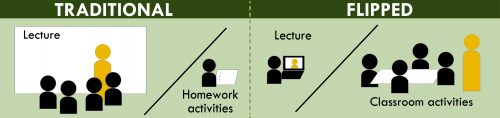
Despite these potential problematic possibilities, Fred Singer, CEO of Echo360 has proposed a broader embrace of what he calls “blended learning,” which “moves beyond simply augmenting face-to-face teaching” and incorporates ways for students to actively participate in video lectures with responses or feedback (Makice). I find the possibilities of “blended learning” to be advantageous and intriguing for teachers of all disciplines, as I already believe flipped classrooms provide students with more flexibility (in taking in lectures on their own time, at their own pace, in their own location), but the additional interactive capabilities proposed by Singer seem designed to authentically replicate the traditional classroom experience in a way that doesn’t breed passivity. Because “humans only retain 10 percent of what we read and 20 percent of what we hear, but comprehend 90 percent of what we say and do,” educational consultant Andrew Miller has supported Singer’s approach, as it provides opportunities for “a variety of instructional models” from “project-or-game-based learning, understanding by design, or authentic literacy” that move flipped classrooms away from mere digital representations of class lectures and into digital experiences of interplay with learning materials (Makice).
By setting up a professional Twitter account, you can discover another way to meet students on a level playing field and boost your knowledge of classroom technological integration tactics outside of flipped classrooms. As silly as it sounds (and believe me, I hesitated at first too), professional Twitter accounts provide teachers with innumerable benefits when it comes to networking and connecting with others in the field. Because it’s easy to get left behind on the plethora of technological advancements that seem to occur every day, Twitter “edubloggers” help keep all teachers on board with the updates of the digital “learning revolution,” and these tweeters can also supply useful, instant information about recent developments in the world of education as a whole (Boss). Now, yes, some accounts can be bogged down by extraneous, non-education-related material. However, if you can tune that chatter out, the accounts that avoid those distractions end up directly and solely relaying helpful content about teaching, and they prove to be easy-to-reach resources when it comes to understanding how to specifically implement new digital programs and activities in lesson plans such as “podcasts, blogs, wikis, and more” (Boss). In order to stay on top of the latest and greatest teaching strategies to engage the 21st century learners in your classroom, it’s imperative that you join social networking in some way or another.
When it comes to interacting with others on Twitter, this task can seem quite daunting at first. This is where Twitter chats come in. Twitter chats “provide educators with classroom-tested lessons, a variety of perspectives on specific problems, or an introduction to emerging technologies,” and they often “focus on just the topic you need” (Fingal). Subscribing to or following a distinctive Twitter chat eliminates much of the time one might waste scouring the entirety of the Twitter app for useful teaching information. To begin, it’s important that one “picks [their] angle,” as “some chats, such as #edchat, tackle a broad range of education issues, while others are based on shared interests in a particular topic, content area, grade level, job type, or geographic region” (Fingal). In my eyes, I believe teachers should subscribe to at least one broad Twitter chat to receive the most basic education and technological news and at least one content area Twitter chat, so that they can receive news about digitization that directly corresponds to their subject matter. The presence of Twitter chats allows teachers a clear and easy entry point to the overwhelming vastness of the Twitter-sphere, and the relationships one forms within these chats will prove to be continually beneficial when it comes to constantly finding new ways to evolve your instruction.
Aside from simply acquainting oneself with technological knowledge, teachers finally also need to work at understanding how their students specifically present themselves online and why in order to properly instruct on digital literacy alongside technological integration. Self-presentation is a challenge for anyone of any age, but it’s particularly difficult for teens who are attempting “to understand how context, audience, and identity” interact in what they post (Boyd 30). We commonly underestimate the ways that teens relay specific content on social media platforms for a specific audience, and this causes us to subsequently make generalizations about a young individual’s personality based on one negative or questionable post. Although “teens often imagine their audience to be those that they’ve chosen to ‘friend’ or ‘follow’,” it’s impossible to fully control “who can see their profile, who actually does see it, and how those who do see it will interpret it,” and they need to be aware of this (Boyd 32). This is different from in-person conversations, in which teens can more expediently switch discussion topics or end interactions if they don’t want someone to hear something; social network posts are available to almost anyone at any time, and those reactions can’t be regulated. It’s wonderful that technology has allowed adolescents to “move quickly between different social settings” and “interact with different groups of friends, interest groups, and classmates” thanks to the diversification of social networking, but some simply lack the proper maturity and capability to effectively manage these separate identities simultaneously until assistance (or punishment) arises (Boyd 41). Since many classrooms now incorporate the use of plentiful technology (as I have also detailed the importance and benefits of above), it is essential that teachers also help guide students through identity work through different contexts and social media platforms. For individuals that have grown up in the digital age, social media has become a form of expression of sorts, and it’s a valuable experience for sure, but as we place more technological tools at our students’ disposal, we must make sure not to leave them high and dry either.
Technology isn’t going anywhere, and it’s overwhelming presence in our lives will only increase as the digital world grows and expands in the coming years. While tech provides plenty of new learning opportunities for teachers (such as the ever-popular “flipped classroom” instructional approach), we have to make sure to both stay on top of the possibilities of digitization and guide our students through this messy, murky environment as well in order to achieve greater professional and educational success for all.
Works Cited
Boss, Suzie. “Twittering, Not Frittering: Professional Development in 140 Characters.” Edutopia, George Lucas Educational Foundation, 13 August 2008, https://www.edutopia.org/twitter-professional-development-technology-microblogging.
Boyd, Danah. “Identity: Why Do Teens Seem Strange Online?” It’s Complicated: The Social Lives of Networked Teens. London: Yale University Press, 2014. 29-52. Print.
Fingal, Diana. “40 education Twitter chats worth your time.” ISTE, International Society for Technology in Education, 16 January 2018, https://www.iste.org/explore/Professional-development/40-education-Twitter-chats-worth-your-time?articleid=7.
Makice, Kevin. “Flipping the Classroom Requires More Than Video.” Wired, Condé Nast, 12 April 2013, https://www.wired.com/2012/04/flipping-the-classroom/.
Thomas, Douglas, and John S. Brown. “Embracing Change.” A New Culture of Learning: Cultivating the Imagination for a World of Constant Change, Scotts Valley: CreateSpace, 2011, 39-49. Print.
University of Washington. “Flipping the classroom.” University of Washington, University of Washington, 2019.
 Zach Gilbert
Zach,
Interaction – that is one of the most important benefits and that we have from the internet. It allows us to interact with our students in a way like never before, but it also allows us to interact with other educators to better ourselves and classrooms. By modeling positive online interactions for our students we are modeling and encouraging our students to do the same, by showing/giving the tools to do so, because like you said, it is becoming apparent that technology clearly cannot be ignored.
Thanks!
LikeLike
Krista,
I wholeheartedly agree! Since it’s clear that we cannot avoid the onslaught of technological resources at our disposal, all we can do is make sure that we provide our students with the tools necessary to conduct themselves in an appropriate and decent manner when utilizing these applications.
LikeLike